

What We Do
Location
123 Business Street, Suite 456
New York, NY 10001, USA
Contact us
Location





Canada is actively shifting its trade focus toward new markets after a year of trade tensions with the United States. Prime Minister Mark Carney is leading a push to diversify markets and reduce reliance on a single trading partner.
The US captures 75% of Canadian trade. For some industries, such as lumber, steel, and aluminum, dependence increases to 90%.
Exploring new markets will benefit Canadian clean tech in many ways. Canada’s cleantech companies don’t just need capital. They need markets.
The domestic market is small, procurement is slow, and large-scale deployment often depends on government programs. International markets offer scale, speed, and a wider variety of buyers.
New markets can provide access to economies that are rapidly expanding their clean energy investments. These markets can adopt solutions more quickly than Canada’s regulated systems, giving Canadian companies a genuine commercial advantage.
Canadian firms possess technical strength in critical minerals, battery materials, hydrogen solutions, cold-climate renewables, carbon management, and grid resilience. Engaging with countries where our technical strengths are in demand will make Canada an attractive market for partnerships.
Investments in clean tech are increasing in Europe and Asia. Carney’s outreach at ASEAN creates a valuable new export and investment corridor for Canada’s cleantech sector.
In October 2025, Mark Carney attended the Association of Southeast Asian Nations (ASEAN) Summit and met with world leaders and investors to strengthen trade, technology, and energy partnerships. During this summit, the Prime Minister announced $25 million in technical assistance to accelerate the development of a new Canada-ASEAN free trade agreement.
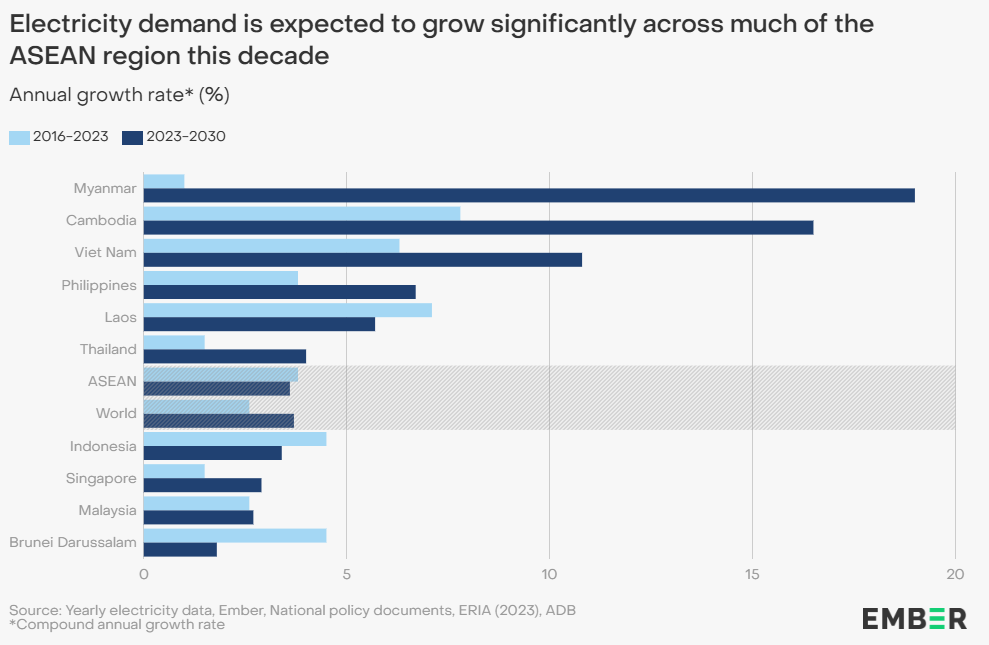
Read more here: Electricity landscape in ASEAN
The free trade agreement will open Canada to a large and fast-growing market for clean technologies.
The ASEAN region is a significant global market, with a population of nearly 700 million people and an economy worth over $4.1 trillion. The region is Canada’s fourth-largest merchandise trade partner, with annual trade valued at $42.3 billion in 2024.
Market growth and cleantech demand in ASEAN
The region is expected to grow at a rate of 4.2%, leading to increased energy consumption, industrialisation and urbanisation. The region experienced a 3.6% increase in electricity consumption in 2023, primarily driven by the use of fossil fuels.
The governments are transitioning toward clean energy with a new commitment to reach 45% renewable electricity by 2030.
To achieve this goal, the region established the ASEAN Power Grid (APG), planning to connect the national electricity grids across member countries, enabling cross-border power trade and stabilising supply.
The Asian Development Bank (ADB) and the World Bank have pledged over US$12 billion to support the APG and broader clean energy infrastructure.
These developments create demand for technologies, including renewable energy (solar, wind, hydro), energy storage, smart‑grid hardware and software, as well as cross-border infrastructure components. That’s a strong signal for cleantech firms to expand their operations across ASEAN.
Companies can benefit from initiatives such as the ASEAN Centre for Energy (ACE), ASEAN Sparks: Ignite, feed‑in tariffs (FiTs), favourable tax incentives, and regulatory support that offer tax breaks, easier foreign investment, and favourable energy off-take.
Canadian firms are well-positioned to capitalize on this growing market. High-potential areas include:
By targeting these sectors, Canadian cleantech companies can leverage global energy growth into a sustainable business opportunity, scaling solutions far beyond the domestic market.
After the ASEAN Summit, Mark Carney made a strategic stop in Singapore. His visit highlighted that Canada’s interest in building trade and investment relationships beyond the traditional blocs, and Singapore offers a unique entry point into Southeast Asia’s clean energy transition.
Singapore is one of the most significant countries in the ASEAN region. It's Asia’s most advanced testbed, finance hub, and policy-driven launchpad for low-carbon technologies.
However, 94–95% of Singapore’s electricity generation comes from natural gas. Renewables remain a small share of the supply. In May 2025, they accounted for approximately 2.58% of electricity generation.
Singapore is rapidly transforming its energy and climate policy. The country aims to reach net-zero emissions by 2050, with a near-term target of 45–50 million tonnes CO₂ equivalent by 2035. Singapore aims to achieve this through its “Four Switches” strategy: Solar, Regional Power Grids, Low-Carbon Alternatives, and Natural Gas.
Focusing on solar for local renewables, regional power grids to import clean energy from neighbouring countries, low-carbon alternatives such as hydrogen and carbon capture, and natural gas as a transitional fuel.
For Canadian cleantech companies, Singapore is more than a trading partner; it’s a launchpad into Asia’s rapidly growing clean energy markets. The country’s push into solar, expanding power grids, low-carbon alternatives, and regional power import projects aligns closely with Canada’s strengths in grid resilience, battery materials, and advanced renewable energy sources.
Singapore’s industrial zones and innovation programmes make it one of the easiest places in Asia to run pilots, secure demonstration sites, or build R&D partnerships. With Singapore mobilizing major capital for clean infrastructure and low-carbon technologies, Canada–Singapore collaboration could unlock funding, off-take opportunities, and long-term commercial pathways for Canadian cleantech exporters.
Carney’s visit, paired with Singapore’s clear, ambitious climate and energy agenda, presents an opportunity to shift from domestic ambitions to global market participation, supported by policy alignment, financing, and regional demand.
After ASEAN and Singapore, Carney made his next stop in South Korea. On October 30, Carney and South Korean President Lee Jae Myung announced a new Canada–Republic of Korea Security and Defence Cooperation Partnership. This is the first formal cooperation framework between Canada and a country in the Indo-Pacific in the defence industry space.
They also reaffirmed the Canada-Korea Free Trade Agreement (CKFTA), noting that bilateral trade has roughly doubled since it came into force 10 years ago, and discussed opportunities to remove remaining trade barriers.
This renewed engagement will increase strategic openings for Canadian clean-tech in energy, critical minerals, infrastructure, and technologies with applications in both civilian and defence sectors.
South Korea is a technology-driven economy undergoing rapid transformation. Its economic strategy is rising demand for advanced energy systems, critical mineral supply chains, clean energy infrastructure, and resilient industrial solutions. Canada’s clean tech strengths align well with these needs.
The new Canada–Korea Security and Defence Cooperation Partnership (CKFTA) will enhance collaboration in dual-use technologies with applications in both defence and industrial supply chains. This could unlock huge opportunities for Canadian cleantech firms in energy storage, clean power infrastructure, critical minerals processing, and emerging sectors such as hydrogen, carbon capture, or grid modernization.
CKFTA gives Canadian exports tariff-free access to the Korean market. With an upcoming Team Canada trade mission planned for 2026, it will offer Canadian cleantech companies a clearer path to enter South Korea. By leveraging Korean supply chains and regional export networks, Canada can access broader markets in the Asia-Pacific region.
2025 was a year for Canada to shed its old ties and explore new opportunities. Next year, we anticipate seeing Canadian businesses expand into new territories. For clean-tech companies, this moment is particularly significant.
From ASEAN’s growing renewable infrastructure to Singapore’s innovation-driven industrial zones and South Korea’s strategic energy partnerships, Canadian firms now have access to markets that value our technical strengths.
By aligning with the ASEAN region’s energy ambitions, leveraging trade agreements, and participating in pilot projects and joint ventures, Canadian clean tech can move from domestic projects to a global scale.
The opportunities are clear: policy alignment, investment support, and regional demand are creating a pathway for Canadian innovation to have a measurable impact on global energy transitions.
For Canada, this shift offers a real opportunity. It moves cleantech from a domestic niche into a global market strategy with long-term economic and energy demand.


